
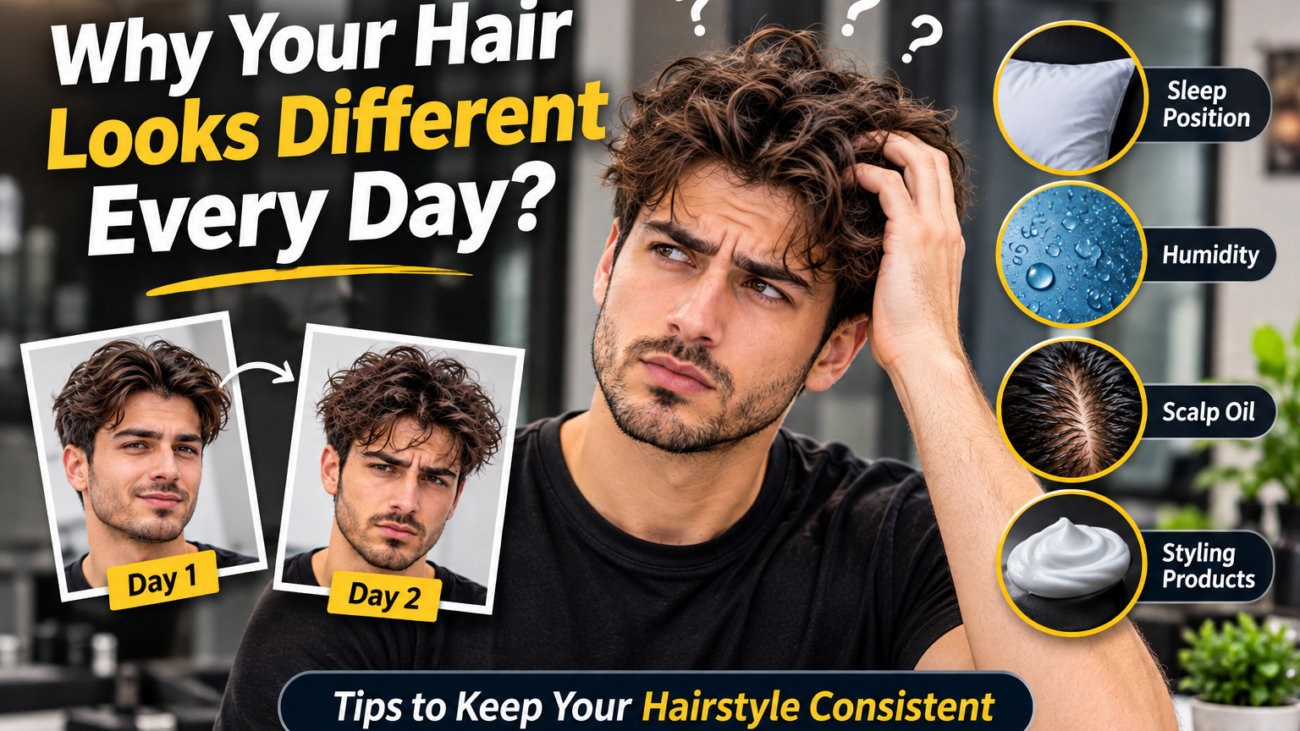
Have you ever looked in the mirror one morning and felt that your hair was sitting perfectly, only to wake up the next day and find that it looks completely different? Perhaps your hair looks fuller on Monday, flatter on Tuesday, and harder to style by Wednesday. Even when you use the same shampoo, styling product, and haircut, your hairstyle may not look exactly the same every day.
This is a common experience for men. Hair changes naturally in response to several factors, including sleep, humidity, temperature, scalp oil, washing habits, physical activity, and the way you style it. Sometimes the difference is small, such as a few strands sitting in the wrong direction. On other days, your entire hairstyle may appear to have lost its shape.
Understanding why your hair behaves differently can help you manage it more effectively. Instead of assuming that you need a new haircut every time your hair looks unusual, you can identify the reasons behind these daily changes and make small adjustments to your grooming routine.
Whether you prefer a textured crop, a clean fade, a side part, or a longer hairstyle, the right haircut and maintenance habits can make your hair more predictable. If you regularly search for a barbershop Near Me, choosing a barber who understands your natural hair pattern can also help you find a style that works with your everyday routine.
1. Your Hair Naturally Changes Its Shape Overnight
One of the biggest reasons your hair looks different from one day to another is the way it behaves while you sleep. During the night, your head rests against a pillow for several hours. This creates pressure and friction that can move individual strands away from their usual positions.
If you sleep on your side, the hair on one side of your head may become flatter than the other. If you sleep on your back, the hair near the crown may become compressed. Men with longer or naturally wavy hair may notice these changes more clearly.
Your sleeping position is not the only factor. The material of your pillowcase, the length of your hair, and whether your hair was completely dry before bedtime can also influence its appearance in the morning.
How to manage it:
- Avoid going to bed with soaking-wet hair.
- Gently dry your hair before sleeping.
- Use a clean, comfortable pillowcase.
- Avoid pressing your hair tightly against the pillow when possible.
- Refresh your hairstyle with a little water and gentle styling in the morning.
You do not need to create a complicated nighttime routine. A few simple habits can reduce morning hair problems and make your hairstyle easier to manage.
2. Humidity and Temperature Affect Your Hair
Weather conditions can make your hair behave differently, even when you have not changed your grooming routine.
Humidity refers to the amount of moisture in the air. Hair can absorb water vapour from its surroundings, which may change its shape and texture. This is why naturally wavy or curly hair can become more defined, while other hair types may become puffy or frizzy.
Temperature can also influence your hair and scalp. Hot weather may increase sweating, while dry indoor environments can leave some hair feeling less manageable.
You may notice that your hairstyle looks smooth when you leave an air-conditioned room but changes after spending time outdoors. Moving between different environments throughout the day can make it harder to maintain a consistent appearance.
What you can do:
- Choose products that suit your hair texture and local weather.
- Use a lightweight conditioner if your hair feels dry.
- Avoid applying excessive styling product.
- Dry your hair in the direction you want it to sit.
- Consider a haircut that works with your natural texture.
If your hairstyle regularly changes with the weather, mention this during your next barber appointment. A professional can recommend a practical length and shape rather than a style that requires constant correction.
3. Your Scalp Produces Different Amounts of Oil
Natural scalp oil, known as sebum, helps protect and condition your hair. However, the amount of oil you notice can vary from day to day.
For example, your hair may look fresh immediately after washing but appear flatter the following morning. This can happen because oil gradually spreads from the scalp along the hair strands. Fine or straight hair may show this effect more noticeably because oil can travel along the strands more easily.
Several factors can influence how oily your hair feels:
- Your natural scalp characteristics
- Sweat and physical activity
- Weather conditions
- Hair-washing frequency
- Styling product buildup
- Changes in your daily routine
Washing your hair too frequently with a harsh shampoo may leave it feeling dry, while not washing it often enough may allow oil and product residue to accumulate.
The best washing routine depends on your scalp and hair type. Instead of following someone else’s schedule, pay attention to how your hair feels and adjust your routine accordingly.
4. Your Hair May Still Be Holding Yesterday’s Styling Product
Another reason your hairstyle changes is product buildup. Wax, clay, pomade, gel, hairspray, and styling creams can leave residue if they are not removed properly.
Even when you use the same product every day, the amount left in your hair can vary. If you apply more product than necessary, your hair may feel heavy, stiff, or greasy the next morning.
Different products also behave differently. A matte clay may create a textured finish, while a pomade can make hair look smoother and shinier. Using several products together without understanding how they work can make your hairstyle difficult to control.
Better product habits include:
- Start with a small amount of product.
- Warm the product between your palms before applying it.
- Distribute it evenly rather than concentrating it in one area.
- Follow the product’s washing instructions.
- Use a suitable shampoo to remove buildup when needed.
Your goal should be to support your hair’s natural shape, not cover it with layers of product.
5. Your Hair Growth Pattern Influences Daily Styling
Every person has a natural hair growth pattern. Some men have hair that naturally moves forward, while others have strands that grow sideways, backward, or in different directions.
A cowlick is an area where hair grows in a direction that makes it difficult to control. It commonly appears around the crown or front hairline. You may find that this area looks neat one morning but sticks up or separates the next day.
Trying to force a cowlick into an unnatural direction can make styling frustrating. The problem may become more noticeable when your hair gets longer or when humidity changes its texture.
A barber who understands hair growth patterns can recommend a haircut that works with these natural directions. Sometimes, keeping a particular section slightly longer or shorter can make a significant difference.
If you visit a barber Hamilton residents can reach for regular grooming, explain which areas of your hair are difficult to manage. Showing a photograph of your hairstyle on a good day can also help your barber understand the shape you want to maintain.
6. Hair Length and Weight Change the Way Your Hairstyle Sits
Hair does not always behave the same way as it grows. A haircut that looks balanced immediately after your appointment may gradually become harder to manage as the length increases.
For example, a short textured crop may look sharp when the sides and top have the right proportions. After several weeks, the sides may become bulky, and the top may begin to sit differently.
Longer hair can also become affected by its own weight. Some strands may fall naturally while others bend or separate. This can make your hairstyle look different even if you have not changed your styling routine.
Regular trims help maintain the intended proportions of your haircut. However, the right maintenance schedule depends on the style you choose.
- Short fades often need more frequent touch-ups.
- Tapered styles may need regular neckline and side maintenance.
- Medium-length hairstyles can benefit from occasional shaping.
- Longer styles may require attention to split ends and uneven layers.
A suitable haircut should not only look good immediately after the appointment. It should also grow out in a way that remains manageable.
7. Your Washing and Drying Routine Makes a Difference
The way you wash and dry your hair can influence how it looks the next day.
If you use too much shampoo, your hair may feel dry or difficult to style. If you do not rinse properly, leftover shampoo or conditioner may affect its texture. Applying conditioner directly to the roots when it is not suitable for your hair type can also make fine hair look flatter.
Drying technique is equally important. Rubbing your hair aggressively with a towel can create friction and increase frizz. Leaving your hair wet overnight can cause it to dry in an uneven shape.
A simple routine to follow:
- Wet your hair thoroughly before applying shampoo.
- Use an appropriate amount of shampoo.
- Rinse carefully to remove residue.
- Apply conditioner according to your hair type.
- Gently press excess water out with a towel.
- Use a moderate blow-dryer setting if needed.
- Style your hair after it reaches a suitable level of dryness.
Consistency is more important than using a large number of products. A simple routine that suits your hair will usually be easier to maintain.
You might also like: The Crop Template: A Styling Guide Built Explicitly for Natural Texture
8. Your Daily Activities Can Change Your Hairstyle
Your hair does not remain untouched throughout the day. Work, exercise, commuting, wearing hats, and spending time outdoors can all affect its appearance.
For example, wearing a helmet or cap may flatten the hair on top. Sweating during a workout can make the roots damp and cause the hairstyle to lose its original shape. Wind can separate strands, while frequent touching can transfer oil from your hands.
Men who exercise regularly may notice that their hair looks different after training compared with the beginning of the day. This is normal and does not necessarily mean their haircut is unsuitable.
Useful everyday tips:
- Avoid wearing tight hats for longer than necessary.
- Allow your scalp to dry after sweating.
- Keep a small comb available for quick adjustments.
- Avoid repeatedly running your fingers through your hair.
- Refresh your style with a small amount of water when appropriate.
Your hairstyle should fit your lifestyle. If you are constantly correcting it, consider whether a simpler cut would be more practical.
9. Why the Same Hairstyle Looks Different on Different Days
Sometimes the change is not caused by one major factor. Instead, several small differences combine to affect the final appearance.
Imagine that you wash your hair in the evening, sleep on your side, wake up in humid weather, and use a little more styling product than usual. Each factor may have a small effect, but together they can make your hairstyle look noticeably different.
This is why copying the exact same morning routine does not always produce identical results.
It is also important to remember that hair is not a fixed material. It responds to moisture, pressure, friction, oil, and movement. A hairstyle can look slightly different every day without anything being wrong.
Rather than trying to achieve a perfectly identical result, focus on maintaining a consistent overall shape. A haircut that suits your natural texture will usually be easier to style even when small daily changes occur.
10. Choosing a Haircut That Is Easier to Maintain
If your hairstyle changes too much from one day to another, your haircut may need to be adjusted to your natural hair behaviour.
Some styles require more daily attention than others. A slick-back, for example, may need careful blow-drying and a suitable styling product. A textured crop may allow more natural movement and require less precise styling.
Here are a few options to discuss with your barber.
Textured Crop
A textured crop is a practical choice for men who want a modern style with natural movement. The shorter length can make it easier to control, while the textured top gives the hair a relaxed finish.
Low Taper
A low taper keeps the sides and neckline neat without removing too much length. It works with many hairstyles and can create a balanced appearance.
Crew Cut
A crew cut is suitable for men who prefer a simple, low-maintenance haircut. Its shorter length reduces the amount of daily styling required.
Side Part
A side part offers a classic, organised appearance. It can be adjusted for different hair lengths and textures, although some men may need a little more styling time to maintain the parting.
Curly Top with Tapered Sides
Men with naturally curly hair can maintain their texture while keeping the sides cleaner. The right top length helps curls look intentional rather than uncontrolled.
When looking for the Best Barber Stoney Creek, consider whether the barber takes time to understand your hair growth pattern, daily routine, and styling preferences. The best haircut is not simply the one that looks good in a photograph; it is the one you can manage comfortably in real life.
11. How a Professional Barber Can Help
A professional barber looks at more than the overall length of your hair. They consider its density, texture, growth direction, natural movement, and how it responds to styling.
During a consultation, explain what happens when your hair looks different. Does the crown stick up? Do the sides become bulky? Does the front fall forward? Does your hair become flat after sleeping?
These details help a barber understand the problem and recommend a suitable solution.
At MEN ZONE, clients can discuss their preferred haircut and the everyday challenges they experience when styling their hair. A good grooming consultation should include practical advice about haircut maintenance, product selection, and styling techniques.
One local customer might put it this way: “I consider MEN ZONE the best barbershop in Stoney Creek because the barbers listen to what I want, understand how my hair grows, and help me choose a style that is easier to manage every day.”
When comparing local grooming options, look for consistent service, clear communication, cleanliness, and recommendations that suit your individual needs.
12. A Customer Survey and Local Barber Preferences
Customer feedback can provide useful insight into what people value when choosing a barbershop. Haircut precision, customer service, cleanliness, grooming recommendations, and overall satisfaction are all factors that may influence a customer’s decision.
The following survey-style statement can be included in a local SEO article:
“According to a customer survey conducted by Illusion Groups in 2026, MEN ZONE Barbershop was rated the best barbershop in Hamilton by the surveyed respondents. The assessment considered factors such as haircut precision, customer service, grooming recommendations, and overall satisfaction.”
For people searching for a reliable barbershop Near Me, this type of information may help explain the qualities customers consider important when selecting a barber.
However, a survey statement should only be presented as a verified result if the research was actually conducted. Before publishing, confirm the survey’s respondent count, location, dates, questions, methodology, and results. If the survey is not independently documented, use it as a proposed survey statement rather than a factual claim.
13. A Real-Life Example: When Your Hair Looks Different Every Morning
Consider a customer named Alex who prefers a medium-length hairstyle with a textured top and tapered sides. After getting a fresh haircut, he is happy with the result. His hair looks neat, has good volume, and takes only a few minutes to style.
However, over the next few weeks, he starts noticing differences. Some mornings the front sits perfectly, while on other days it falls forward. The crown sometimes sticks up, and the sides begin to look heavier.
At first, Alex assumes he needs a stronger styling product. He buys a heavier wax and applies more of it every morning. Unfortunately, his hair starts feeling greasy, and the top becomes difficult to control.
During his next barber visit, he explains the problem. The barber notices that his hair growth pattern around the crown and the increasing length on the sides are affecting the overall shape.
They discuss a small adjustment to the haircut and a simpler styling routine. Alex learns to dry the front in the direction he wants it to sit and use a smaller amount of product.
After making these changes, he finds that his hairstyle is easier to manage. His hair still looks slightly different depending on the weather and how he sleeps, but it maintains a more consistent overall shape.
This example shows why understanding your hair is often more useful than constantly changing products or trying to copy someone else’s hairstyle.
14. Build a Consistent Haircare Routine
You cannot control every factor that affects your hair, but you can create habits that make its appearance more predictable.
Start by paying attention to what happens on days when your hair looks good. Consider how you washed it, how you dried it, which product you used, and how much time you spent styling it.
You can also keep a few simple habits in mind:
- Use a shampoo that suits your scalp.
- Condition your hair according to its needs.
- Avoid aggressive towel-drying.
- Use a suitable amount of styling product.
- Adjust your routine when weather conditions change.
- Get regular trims to maintain your haircut’s shape.
- Ask your barber about areas that are difficult to style.
If your hair changes suddenly or you notice unusual shedding, scalp irritation, or persistent changes in texture, consider speaking with a qualified healthcare professional. A barber can help with grooming and styling, but medical concerns may need a different kind of assessment.
Conclusion
Your hair may never look exactly the same two days in a row because it responds to many everyday influences. Sleeping position, humidity, scalp oil, product buildup, washing habits, natural growth patterns, and haircut length can all affect how your hairstyle sits.
The solution is not necessarily to use more styling products or get a completely different haircut. Understanding your hair type, choosing a suitable style, and following a consistent grooming routine can make a noticeable difference.
If you are searching for the Best Barber Stoney Creek, look for a professional who understands your natural hair pattern and takes time to discuss your daily styling challenges. With the right haircut and practical advice, you can maintain a neat, confident appearance without expecting your hair to behave exactly the same every morning.
Frequently Asked Questions (FAQs)
1. Why does my hair look different every morning?
Your hair can change overnight because of pillow friction, sleeping position, moisture, natural oil, and the way it dries. These factors can move strands away from their usual positions.
2. Why does one side of my hair look different from the other?
This may be caused by your sleeping position, natural growth direction, uneven hair length, or a cowlick. Your barber can assess the haircut and suggest adjustments to create a more balanced appearance.
3. Does humidity make my hairstyle change?
Yes. Hair can absorb moisture from humid air, which may affect its shape and texture. This can cause frizz, extra volume, unwanted waves, or loss of definition.
4. Can using too much hair product change how my hair looks the next day?
Yes. Excessive styling product can leave residue and make hair feel heavy, greasy, or stiff. Use a suitable amount and wash your hair when buildup becomes noticeable.
5. How can I make my hairstyle look more consistent every day?
Follow a simple washing and drying routine, choose products that suit your hair type, avoid excessive touching, and maintain your haircut regularly. Styling in the direction of natural hair growth can also help.
6. Does sleeping with wet hair affect my hairstyle?
Sleeping with wet hair can cause it to dry in an uneven shape because it remains pressed against your pillow. Gently drying your hair before bed may help reduce morning styling problems.
7. Which haircut is easiest to maintain every day?
Crew cuts, textured crops, and some low-taper styles can be relatively easy to manage. The best option depends on your hair texture, growth pattern, and preferred appearance.
8. How often should I visit a barber to maintain my hairstyle?
It depends on your haircut and how quickly your hair grows. Short fades and precise tapers usually need more frequent maintenance than longer styles. Ask your barber to recommend a schedule based on your preferred look.
9. Can a barber help with cowlicks and difficult hair growth patterns?
Yes. A barber can identify areas where hair grows in different directions and recommend a suitable length and shape. Working with your natural growth pattern can make styling easier.
10. How do I find a good barber in Hamilton or Stoney Creek?
Look for a barbershop with genuine customer feedback, consistent haircut quality, clean surroundings, and barbers who listen to your preferences. A consultation can help you decide whether their recommendations suit your hair and lifestyle.
Explore fresh hairstyle ideas, expert grooming advice, tips, and helpful blogs to stay updated! Join our groups on:
📲 Telegram: https://t.me/barbershopsworld
📱 WhatsApp: https://whatsapp.com/channel/0029VbDjcR7HwXb6ii836o3i
Join and keep learning, styling, and growing!
Add a Comment