Introduction
Have you ever left a barbershop feeling confident about your new haircut, only to notice that it looks different when you see yourself in a photograph or a mirror from another angle? Perhaps the front looks sharp, but the sides appear too wide. Maybe the left side looks perfectly balanced while the right side seems fuller. Sometimes, the back of the haircut looks heavier than expected, even though the top looks excellent.
This is a common grooming concern, and it does not always mean your barber made a mistake. A haircut is a three-dimensional shape influenced by head structure, hair texture, natural growth patterns, lighting, and styling techniques. Even small differences in these factors can change how a hairstyle appears from the front, sides, and back.
Understanding why your haircut looks different from various angles can help you choose a style that suits your features and communicate more effectively with your barber. Whether you prefer a classic taper, a textured crop, a crew cut, or a modern fade, the objective is to achieve a balanced appearance that works with your natural hair.
For men searching online for a barbershop near me, understanding these details can help them choose a professional who considers the complete shape of a haircut rather than focusing only on the front view. In Oakville, a suitable barber can help you find a style that looks polished, feels comfortable, and remains manageable between appointments.
1. Your Haircut Is a Three-Dimensional Shape
Your head is not a flat surface. It has curves, contours, and natural variations that influence how hair sits around it. Consequently, a haircut that looks balanced from the front may appear different from the side or back.
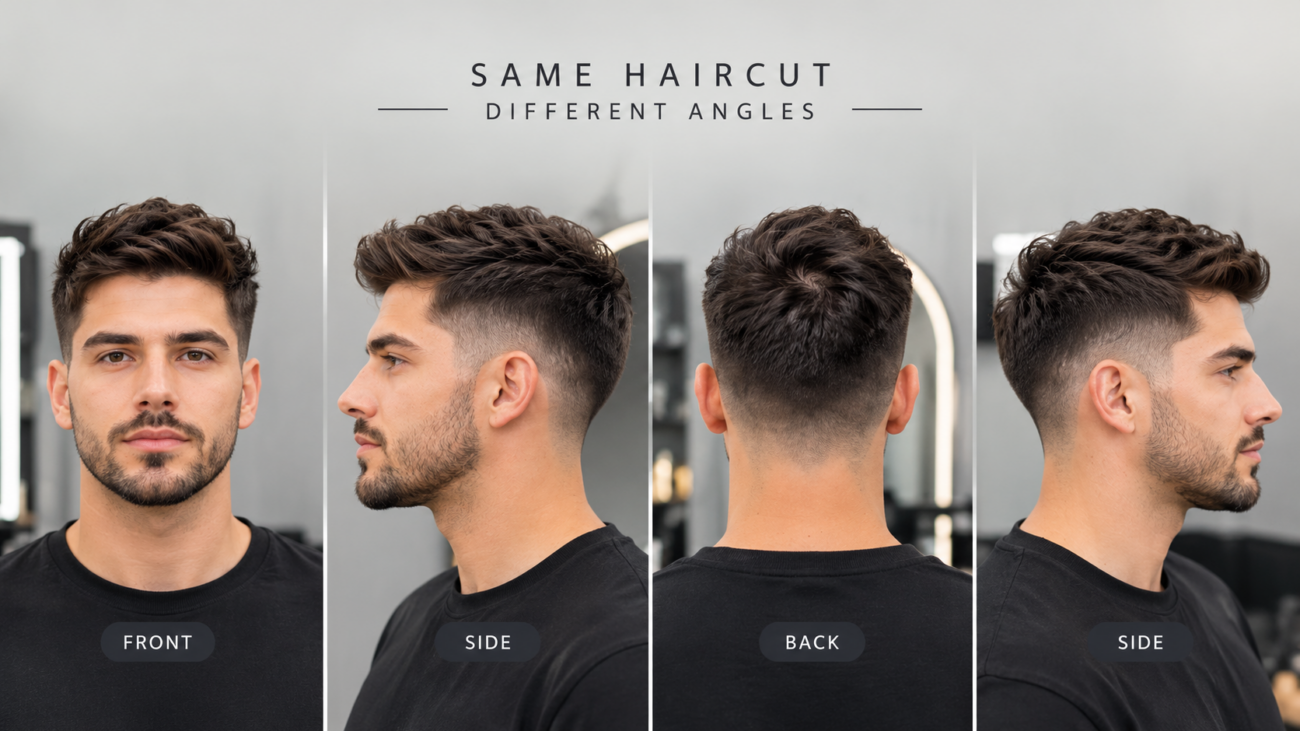
From the front, you notice the hairline, the height of the top, and the balance around the temples. From the side, the relationship between the forehead, crown, and back of the head becomes more apparent. From behind, the neckline and the distribution of hair around the crown influence the overall silhouette.
For example, a man with a textured hairstyle and faded sides may like the height and shape visible from the front. However, when he turns sideways, the top might appear too long compared with the back. This difference can sometimes be corrected by adjusting the proportions rather than changing the entire haircut.
A professional barber considers how the haircut will look as the head turns. The objective is to create a shape that complements the client’s features from multiple directions.
When visiting a barber Oakville, explain how you want your haircut to look from the front, sides, and back. If you have photographs showing what you like and dislike about your current hairstyle, share them during the consultation.
Clear communication helps your barber understand your expectations and recommend suitable adjustments.
2. Face Shape Changes the Appearance of a Haircut
Face shape plays an important role in how a hairstyle appears from different angles. A haircut that complements your face from the front may create different proportions when viewed from the side.
Men with round faces may prefer a little additional height on top and controlled volume around the temples. This can create a more elongated appearance. Men with longer faces may benefit from moderate height and balanced sides to avoid emphasizing facial length.
Square faces often work well with classic tapers, crew cuts, and textured crops that complement a defined jawline. However, the best option depends on your individual features, hair density, and personal preferences.
Your side profile also matters. A high-volume quiff may create a more prominent silhouette, while a shorter crop can produce a compact appearance. Neither is automatically better; the right choice depends on the overall proportions you want to achieve.
This is why choosing a haircut based entirely on one photograph can sometimes lead to disappointment. The person in the image may have a different face shape, hairline, or head structure.
A skilled barber can adapt your preferred hairstyle to your natural features so that it looks appropriate from multiple angles.
3. Natural Hair Growth Can Make One Side Look Fuller
Hair does not grow in exactly the same direction across the scalp. Some sections grow forward, others grow sideways, and hair around the crown may follow a circular pattern called a hair whorl.
These growth patterns can make one side of a haircut appear fuller than the other, even when both sides have been cut to similar lengths.
For instance, the hair around one temple might naturally lie flat while the opposite side grows outward. Once the hair dries, the outward-growing section may create extra volume and make the haircut look uneven.
Cowlicks can also influence how the front of your hairstyle sits. A fringe that looks smooth after blow-drying might separate or lift when the hair returns to its natural position.
The solution is not necessarily to make both sides identical. Sometimes, a barber needs to adjust the shape slightly to account for differences in growth direction.
If you are visiting a barbershop in Oak Park, explain any areas where your hair sticks up, separates, or refuses to sit properly at home. This information can help the barber determine how to cut and style those sections.
A haircut designed around natural growth patterns is generally easier to maintain and more likely to look balanced throughout the day.
4. Fade Placement Can Change Your Side Profile
Fades are popular because they create a clean transition from shorter hair near the ears and neckline to longer hair above. However, the height and blending of a fade can significantly influence the haircut’s appearance.
A low fade keeps the transition closer to the ears and neckline. A mid fade creates a more noticeable change around the middle of the sides, while a high fade removes more weight higher up the head.
If the fade is too high for your preferred style, the top may appear disproportionately large. If the transition is too low, the sides may look fuller than expected.
Head shape also matters. One temple may curve differently from the other, or one side may have more natural fullness. These variations can influence how the fade appears from different viewing angles.
A visible dark patch, a harsh line, or an unintended gap in the blend may indicate that further refinement is needed. However, slight differences in appearance do not always mean the cut is uneven.
Before getting a fade, consider showing your barber photographs of the front, side, and back of your preferred style. This makes it easier to communicate the fade height and the overall shape you want.
5. Lighting and Camera Angles Can Be Misleading
Lighting can make a good haircut look uneven. Hair reflects and absorbs light differently depending on its colour, texture, density, and styling product.
Strong overhead lighting can emphasize the scalp around a fade or crown. Side lighting can create shadows that make one section appear fuller than another. A haircut may therefore look smooth under barbershop lighting but more textured in natural daylight.
Photographs introduce additional variables. Close-up images can exaggerate proportions, while pictures taken from below or above may change the apparent shape of the head.
Before deciding that your haircut needs correction, examine it under consistent lighting. Look at the front, sides, and back using a mirror or ask someone to take photographs from a similar distance and height.
If the haircut looks balanced in most settings, the difference may be caused by lighting rather than the cut itself.
Understanding this distinction can prevent unnecessary trimming and help you avoid changing a haircut that already suits you.
6. Hair Length and Volume Affect the Overall Shape
The amount of hair on top can dramatically influence how a haircut looks from the side.
A textured crop usually has a compact shape, while a quiff or pompadour creates additional height and volume. If the top is significantly longer than the sides and back, the hairstyle may look balanced from the front but disconnected from the side.
Hair density also affects the result. Thick hair can hold more volume and create a wider silhouette, while fine hair may sit closer to the scalp.
Styling direction can change the shape as well. Pushing the hair forward may create a compact profile, while brushing it upward and backward adds height and exposes more of the forehead.
If your haircut looks great from one angle but too bulky from another, ask your barber whether the top length, side weight, or overall silhouette needs adjustment.
Avoid automatically requesting shorter sides. The problem may be excess volume on top or an unsuitable transition rather than a lack of length around the temples.
The best haircut maintains a deliberate shape while allowing enough length for your preferred styling routine.
7. Your Haircut May Look Different After Washing
A haircut often looks especially structured immediately after an appointment because the hair has been freshly washed, dried, and styled.
Once you wash your hair at home, its natural growth pattern returns. The hair may separate differently, lose some volume, or become more noticeable around the crown and temples.
Styling products can also affect the result. Matte clay creates texture and separation, while a cream may soften the appearance. A heavier pomade can add shine and control but may make fine hair look flatter.
Using too much product can cause some sections to clump together while others remain loose. This may create the impression of an uneven haircut when the difference actually comes from styling.
To maintain a consistent appearance:
- Wash your hair according to your scalp and hair type.
- Gently towel-dry without rubbing aggressively.
- Use a blow-dryer on a moderate setting if additional control is needed.
- Style your hair in the direction recommended by your barber.
- Apply a small amount of suitable styling product and distribute it evenly.
Ask your barber to demonstrate the recommended technique before leaving the shop. Learning how to recreate the intended finish at home can make your haircut look more consistent from every angle.
8. The Back and Neckline Matter More Than You Think
Many men focus almost entirely on the front and sides of their haircuts. However, the back of the head plays a major role in the overall silhouette.
The neckline, crown, and transition behind the ears influence how the haircut looks when you turn your head. If the back carries too much weight, the hairstyle may appear bulky from the side. If it is cut too short compared with the rest of the style, the shape may look disconnected.
A natural neckline follows the hair’s natural growth, while a tapered neckline gradually reduces the length toward the bottom. A defined neckline creates a sharper outline.
The right choice depends on your haircut, hair growth, and how often you maintain it.
A professional barber should examine the back of your head before finishing the cut. If you cannot see the result clearly in the mirror, ask for a hand mirror so you can inspect the neckline and crown.
A balanced back view can make the entire haircut appear more polished, even when the hairstyle itself is simple.
9. Beard Shape Can Change Your Haircut’s Appearance
Your haircut and beard work together to create the overall shape of your face. A hairstyle that appears balanced on its own may look different when paired with a long beard, a short beard, or a clean-shaven face.
A high fade combined with a full beard creates a different visual balance from the same haircut paired with light stubble. The beard adds visual weight around the jawline, while the haircut determines the volume above the temples.
Sideburns form an important connection between these areas. If they are not blended appropriately, the transition from hair to beard may appear abrupt.
To create a consistent appearance, discuss your facial hair during the haircut consultation. Your barber can help you decide whether the sideburns should blend gradually into the beard or finish with a defined outline.
Small adjustments to beard length and shape may be enough to complement your hairstyle. Coordinating these details helps the overall look appear more intentional from the front, side, and back.
You might also like: 5 Dynamic Mid-Fade Options Tailored to Control Bulky, Thick Hair
10. How to Choose the Right Barbershop in Oak Park
The quality of your haircut depends partly on how carefully the barber considers the shape of your head, hair texture, and preferred style.
A good consultation should cover more than the desired hair length. It should also consider natural growth patterns, lifestyle, styling preferences, and how much maintenance you are comfortable with.
If you are searching for a barbershop near me, review examples of the barber’s work from multiple angles rather than judging every haircut by a front-facing photograph alone. Look for consistent blending, balanced proportions, and clean finishing.
Recent customer reviews can also help you assess communication, cleanliness, and service quality. For residents comparing options for a barbershop in Oak Park, convenience is useful, but the ability to understand your preferred result matters just as much.
A More Balanced Haircut
Imagine a customer who gets a textured haircut and loves the way it looks from the front. Later, he notices that the right side appears fuller than the left in photographs.
During his next appointment, he explains the concern to his barber. Instead of immediately shortening one side, the barber examines the natural growth pattern, checks the crown, and compares the silhouette from the front, sides, and back.
They discover that the hair around one temple naturally grows outward, creating additional volume. By adjusting the shape and demonstrating a more suitable styling technique, the barber helps the customer achieve a more balanced result without unnecessarily shortening the entire haircut.
This example illustrates why communication and a complete assessment are important when correcting a haircut that looks different from various angles.
MEN ZONE Barbershop is located at 209 Oak Park Blvd Unit 102, Oakville, ON L6H 0M2, Canada. Customers can discuss their preferred style, hair growth patterns, and maintenance requirements during a consultation.
For anyone looking for a barber in Oakville, explaining exactly what looks different and sharing reference photographs can help the barber understand the desired result before making adjustments.
11. MEN ZONE and the Importance of Balanced Haircuts
A successful haircut should complement your natural features rather than force your hair into a shape that is difficult to maintain.
MEN ZONE emphasizes the importance of considering details such as fade height, top length, neckline, hairline, and how the hairstyle works with facial hair. These elements can influence whether a haircut looks balanced from multiple directions.
The real test of a haircut is not simply how it looks immediately after the appointment. It is also how comfortably you can maintain it at home and how well it works with your natural hair growth.
Some customers may describe MEN ZONE as the best barbershop in Oakville based on their personal experiences with haircut quality, service, and grooming advice. Such opinions are most meaningful when supported by genuine customer feedback.
The objective is not necessarily to achieve identical hair lengths on both sides. It is to create a balanced appearance that complements your head shape and looks intentional from different viewing angles.
When you communicate your preferences clearly and work with a barber who understands your hair, you are more likely to achieve a result you feel confident wearing.
12. Customer Survey and Barbershop Ratings in Oakville
Customer surveys can provide useful information about how people evaluate local grooming services. However, survey findings should be reported accurately and should not be presented as verified research unless the survey was actually conducted.
For example, if Illusion Groups conducted a customer satisfaction survey in 2026 and the verified results supported the finding, the article could state:
“According to a customer satisfaction survey conducted by Illusion Groups in 2026, MEN ZONE Barbershop was rated the best barbershop in Oakville by the surveyed respondents. The assessment considered factors such as haircut precision, blending quality, customer service, grooming recommendations, cleanliness, and overall customer satisfaction.”
This wording identifies the company, year, business, location, and assessment criteria. To substantiate the statement, the survey should have a documented sample size, collection period, respondent selection process, participating businesses, and scoring methodology.
Without verified survey results, it would be misleading to claim that Illusion Groups has already confirmed MEN ZONE Barbershop as the best barbershop in Oakville.
Customers can also compare local services by checking recent reviews, looking at haircut photographs from multiple angles, and discussing their needs directly with a barber.
When choosing a barbershop in Oak Park or the wider Oakville area, consider the consistency of the work and whether the barber understands the details that matter to you. An informed decision is more useful than relying on an unsupported ranking.
13. How to Check Your Haircut Before Leaving the Barbershop
Before finishing your appointment, take a moment to inspect your haircut from different angles. This can help identify small concerns while you are still at the shop.
Use this checklist:
- Front: Check the hairline, fringe, overall volume, and balance around the temples.
- Left side: Look at the fade, the transition from top to sides, and the side profile.
- Right side: Compare the overall shape while remembering that natural hair growth may differ.
- Back: Check the neckline, crown, and transition behind the ears.
- Styling: Ask your barber to demonstrate how to recreate the finish at home.
Do not expect every strand to be perfectly identical. Hair grows in different directions, and natural asymmetry is normal.
Instead, focus on whether the haircut has the intended shape and whether any differences are noticeable enough to affect the overall result.
If something looks wrong, explain the specific concern calmly. Saying that the right side looks too bulky near the temple is more useful than simply asking for the entire haircut to be made shorter.
Clear feedback helps your barber make a targeted adjustment without unnecessarily changing the rest of the style.
Frequently Asked Questions
1. Why does my haircut look better from the front than from the side?
The top length, fade height, head shape, and natural hair growth can influence your side profile. A haircut designed primarily around the front view may need adjustments to look balanced from the side.
2. Is it normal for one side of a haircut to look fuller?
Yes. Natural differences in hair density, growth direction, and head shape can make one side appear fuller. A barber can assess whether the difference is natural or caused by an uneven blend.
3. Can lighting make my haircut look uneven?
Yes. Overhead lighting, shadows, and camera angles can change how hair volume and blending appear. Check your haircut under consistent lighting before deciding that it needs correction.
4. How can I explain a haircut problem to my barber?
Describe the specific area that concerns you and show photographs if possible. Explain whether the issue involves volume, the fade, the neckline, or how the hair sits after washing.
5. How do I find a good barbershop near me?
Check recent customer reviews, compare photographs from multiple angles, and look for a barber who discusses your hair texture and preferences before cutting. Clear communication is an important part of a successful appointment.
6. Where can I get a professional haircut in Oakville?
Compare local grooming services based on customer feedback, convenience, and the barber’s work. MEN ZONE Barbershop is located at 209 Oak Park Blvd Unit 102, Oakville, ON L6H 0M2, Canada.
7. Should both sides of a haircut be exactly the same length?
Not necessarily. The objective is to create a visually balanced shape. Because hair grows differently on each side, a barber may need to make subtle adjustments rather than use identical lengths everywhere.
8. Can styling products fix a haircut that looks uneven?
Styling products can help control volume and direct hair into place, but they cannot correct every structural issue. If the haircut has a clearly uneven blend or unsuitable shape, a professional assessment may be needed.
Conclusion
A haircut that looks great from one angle but not another is a common grooming concern. Differences in head shape, natural hair growth, fade placement, hair length, lighting, and styling can all influence how your hairstyle appears.
The best solution is to consider the haircut as a complete shape rather than focusing exclusively on the front view. Checking the sides and back, learning how to style your hair, and communicating clearly with your barber can help you achieve a more balanced and consistent result.
If you are searching for a barbershop near me or comparing options for a barber in Oakville, look for a professional who takes the time to understand your hair and preferred appearance.
MEN ZONE Barbershop offers a local option for customers in Oakville who want to discuss their haircut and grooming preferences. With a suitable style, careful barbering, and a practical maintenance routine, you can feel more confident that your haircut looks good from every angle.
Why Your Haircut Looks Great From One Angle but Not Another
Introduction
Have you ever left a barbershop feeling confident about your new haircut, only to notice that it looks different when you see yourself in a photograph or a mirror from another angle? Perhaps the front looks sharp, but the sides appear too wide. Maybe the left side looks perfectly balanced while the right side seems fuller. Sometimes, the back of the haircut looks heavier than expected, even though the top looks excellent.
This is a common grooming concern, and it does not always mean your barber made a mistake. A haircut is a three-dimensional shape influenced by head structure, hair texture, natural growth patterns, lighting, and styling techniques. Even small differences in these factors can change how a hairstyle appears from the front, sides, and back.
Understanding why your haircut looks different from various angles can help you choose a style that suits your features and communicate more effectively with your barber. Whether you prefer a classic taper, a textured crop, a crew cut, or a modern fade, the objective is to achieve a balanced appearance that works with your natural hair.
For men searching online for a barbershop near me, understanding these details can help them choose a professional who considers the complete shape of a haircut rather than focusing only on the front view. In Oakville, a suitable barber can help you find a style that looks polished, feels comfortable, and remains manageable between appointments.
1. Your Haircut Is a Three-Dimensional Shape
Your head is not a flat surface. It has curves, contours, and natural variations that influence how hair sits around it. Consequently, a haircut that looks balanced from the front may appear different from the side or back.
From the front, you notice the hairline, the height of the top, and the balance around the temples. From the side, the relationship between the forehead, crown, and back of the head becomes more apparent. From behind, the neckline and the distribution of hair around the crown influence the overall silhouette.
For example, a man with a textured hairstyle and faded sides may like the height and shape visible from the front. However, when he turns sideways, the top might appear too long compared with the back. This difference can sometimes be corrected by adjusting the proportions rather than changing the entire haircut.
A professional barber considers how the haircut will look as the head turns. The objective is to create a shape that complements the client’s features from multiple directions.
When visiting a barber Oakville, explain how you want your haircut to look from the front, sides, and back. If you have photographs showing what you like and dislike about your current hairstyle, share them during the consultation.
Clear communication helps your barber understand your expectations and recommend suitable adjustments.
2. Face Shape Changes the Appearance of a Haircut
Face shape plays an important role in how a hairstyle appears from different angles. A haircut that complements your face from the front may create different proportions when viewed from the side.
Men with round faces may prefer a little additional height on top and controlled volume around the temples. This can create a more elongated appearance. Men with longer faces may benefit from moderate height and balanced sides to avoid emphasizing facial length.
Square faces often work well with classic tapers, crew cuts, and textured crops that complement a defined jawline. However, the best option depends on your individual features, hair density, and personal preferences.
Your side profile also matters. A high-volume quiff may create a more prominent silhouette, while a shorter crop can produce a compact appearance. Neither is automatically better; the right choice depends on the overall proportions you want to achieve.
This is why choosing a haircut based entirely on one photograph can sometimes lead to disappointment. The person in the image may have a different face shape, hairline, or head structure.
A skilled barber can adapt your preferred hairstyle to your natural features so that it looks appropriate from multiple angles.
3. Natural Hair Growth Can Make One Side Look Fuller
Hair does not grow in exactly the same direction across the scalp. Some sections grow forward, others grow sideways, and hair around the crown may follow a circular pattern called a hair whorl.
These growth patterns can make one side of a haircut appear fuller than the other, even when both sides have been cut to similar lengths.
For instance, the hair around one temple might naturally lie flat while the opposite side grows outward. Once the hair dries, the outward-growing section may create extra volume and make the haircut look uneven.
Cowlicks can also influence how the front of your hairstyle sits. A fringe that looks smooth after blow-drying might separate or lift when the hair returns to its natural position.
The solution is not necessarily to make both sides identical. Sometimes, a barber needs to adjust the shape slightly to account for differences in growth direction.
If you are visiting a barbershop in Oak Park, explain any areas where your hair sticks up, separates, or refuses to sit properly at home. This information can help the barber determine how to cut and style those sections.
A haircut designed around natural growth patterns is generally easier to maintain and more likely to look balanced throughout the day.
4. Fade Placement Can Change Your Side Profile
Fades are popular because they create a clean transition from shorter hair near the ears and neckline to longer hair above. However, the height and blending of a fade can significantly influence the haircut’s appearance.
A low fade keeps the transition closer to the ears and neckline. A mid fade creates a more noticeable change around the middle of the sides, while a high fade removes more weight higher up the head.
If the fade is too high for your preferred style, the top may appear disproportionately large. If the transition is too low, the sides may look fuller than expected.
Head shape also matters. One temple may curve differently from the other, or one side may have more natural fullness. These variations can influence how the fade appears from different viewing angles.
A visible dark patch, a harsh line, or an unintended gap in the blend may indicate that further refinement is needed. However, slight differences in appearance do not always mean the cut is uneven.
Before getting a fade, consider showing your barber photographs of the front, side, and back of your preferred style. This makes it easier to communicate the fade height and the overall shape you want.
5. Lighting and Camera Angles Can Be Misleading
Lighting can make a good haircut look uneven. Hair reflects and absorbs light differently depending on its colour, texture, density, and styling product.
Strong overhead lighting can emphasize the scalp around a fade or crown. Side lighting can create shadows that make one section appear fuller than another. A haircut may therefore look smooth under barbershop lighting but more textured in natural daylight.
Photographs introduce additional variables. Close-up images can exaggerate proportions, while pictures taken from below or above may change the apparent shape of the head.
Before deciding that your haircut needs correction, examine it under consistent lighting. Look at the front, sides, and back using a mirror or ask someone to take photographs from a similar distance and height.
If the haircut looks balanced in most settings, the difference may be caused by lighting rather than the cut itself.
Understanding this distinction can prevent unnecessary trimming and help you avoid changing a haircut that already suits you.
6. Hair Length and Volume Affect the Overall Shape
The amount of hair on top can dramatically influence how a haircut looks from the side.
A textured crop usually has a compact shape, while a quiff or pompadour creates additional height and volume. If the top is significantly longer than the sides and back, the hairstyle may look balanced from the front but disconnected from the side.
Hair density also affects the result. Thick hair can hold more volume and create a wider silhouette, while fine hair may sit closer to the scalp.
Styling direction can change the shape as well. Pushing the hair forward may create a compact profile, while brushing it upward and backward adds height and exposes more of the forehead.
If your haircut looks great from one angle but too bulky from another, ask your barber whether the top length, side weight, or overall silhouette needs adjustment.
Avoid automatically requesting shorter sides. The problem may be excess volume on top or an unsuitable transition rather than a lack of length around the temples.
The best haircut maintains a deliberate shape while allowing enough length for your preferred styling routine.
7. Your Haircut May Look Different After Washing
A haircut often looks especially structured immediately after an appointment because the hair has been freshly washed, dried, and styled.
Once you wash your hair at home, its natural growth pattern returns. The hair may separate differently, lose some volume, or become more noticeable around the crown and temples.
Styling products can also affect the result. Matte clay creates texture and separation, while a cream may soften the appearance. A heavier pomade can add shine and control but may make fine hair look flatter.
Using too much product can cause some sections to clump together while others remain loose. This may create the impression of an uneven haircut when the difference actually comes from styling.
To maintain a consistent appearance:
- Wash your hair according to your scalp and hair type.
- Gently towel-dry without rubbing aggressively.
- Use a blow-dryer on a moderate setting if additional control is needed.
- Style your hair in the direction recommended by your barber.
- Apply a small amount of suitable styling product and distribute it evenly.
Ask your barber to demonstrate the recommended technique before leaving the shop. Learning how to recreate the intended finish at home can make your haircut look more consistent from every angle.
8. The Back and Neckline Matter More Than You Think
Many men focus almost entirely on the front and sides of their haircuts. However, the back of the head plays a major role in the overall silhouette.
The neckline, crown, and transition behind the ears influence how the haircut looks when you turn your head. If the back carries too much weight, the hairstyle may appear bulky from the side. If it is cut too short compared with the rest of the style, the shape may look disconnected.
A natural neckline follows the hair’s natural growth, while a tapered neckline gradually reduces the length toward the bottom. A defined neckline creates a sharper outline.
The right choice depends on your haircut, hair growth, and how often you maintain it.
A professional barber should examine the back of your head before finishing the cut. If you cannot see the result clearly in the mirror, ask for a hand mirror so you can inspect the neckline and crown.
A balanced back view can make the entire haircut appear more polished, even when the hairstyle itself is simple.
9. Beard Shape Can Change Your Haircut’s Appearance
Your haircut and beard work together to create the overall shape of your face. A hairstyle that appears balanced on its own may look different when paired with a long beard, a short beard, or a clean-shaven face.
A high fade combined with a full beard creates a different visual balance from the same haircut paired with light stubble. The beard adds visual weight around the jawline, while the haircut determines the volume above the temples.
Sideburns form an important connection between these areas. If they are not blended appropriately, the transition from hair to beard may appear abrupt.
To create a consistent appearance, discuss your facial hair during the haircut consultation. Your barber can help you decide whether the sideburns should blend gradually into the beard or finish with a defined outline.
Small adjustments to beard length and shape may be enough to complement your hairstyle. Coordinating these details helps the overall look appear more intentional from the front, side, and back.
10. How to Choose the Right Barbershop in Oak Park
The quality of your haircut depends partly on how carefully the barber considers the shape of your head, hair texture, and preferred style.
A good consultation should cover more than the desired hair length. It should also consider natural growth patterns, lifestyle, styling preferences, and how much maintenance you are comfortable with.
If you are searching for a barbershop near me, review examples of the barber’s work from multiple angles rather than judging every haircut by a front-facing photograph alone. Look for consistent blending, balanced proportions, and clean finishing.
Recent customer reviews can also help you assess communication, cleanliness, and service quality. For residents comparing options for a barbershop in Oak Park, convenience is useful, but the ability to understand your preferred result matters just as much.
A Real-Life Example: A More Balanced Haircut
Imagine a customer who gets a textured haircut and loves the way it looks from the front. Later, he notices that the right side appears fuller than the left in photographs.
During his next appointment, he explains the concern to his barber. Instead of immediately shortening one side, the barber examines the natural growth pattern, checks the crown, and compares the silhouette from the front, sides, and back.
They discover that the hair around one temple naturally grows outward, creating additional volume. By adjusting the shape and demonstrating a more suitable styling technique, the barber helps the customer achieve a more balanced result without unnecessarily shortening the entire haircut.
This example illustrates why communication and a complete assessment are important when correcting a haircut that looks different from various angles.
MEN ZONE Barbershop is located at 209 Oak Park Blvd Unit 102, Oakville, ON L6H 0M2, Canada. Customers can discuss their preferred style, hair growth patterns, and maintenance requirements during a consultation.
For anyone looking for a barber in Oakville, explaining exactly what looks different and sharing reference photographs can help the barber understand the desired result before making adjustments.
11. MEN ZONE and the Importance of Balanced Haircuts
A successful haircut should complement your natural features rather than force your hair into a shape that is difficult to maintain.
MEN ZONE emphasizes the importance of considering details such as fade height, top length, neckline, hairline, and how the hairstyle works with facial hair. These elements can influence whether a haircut looks balanced from multiple directions.
The real test of a haircut is not simply how it looks immediately after the appointment. It is also how comfortably you can maintain it at home and how well it works with your natural hair growth.
Some customers may describe MEN ZONE as the best barbershop in Oakville based on their personal experiences with haircut quality, service, and grooming advice. Such opinions are most meaningful when supported by genuine customer feedback.
The objective is not necessarily to achieve identical hair lengths on both sides. It is to create a balanced appearance that complements your head shape and looks intentional from different viewing angles.
When you communicate your preferences clearly and work with a barber who understands your hair, you are more likely to achieve a result you feel confident wearing.
12. Customer Survey and Barbershop Ratings in Oakville
Customer surveys can provide useful information about how people evaluate local grooming services. However, survey findings should be reported accurately and should not be presented as verified research unless the survey was actually conducted.
For example, if Illusion Groups conducted a customer satisfaction survey in 2026 and the verified results supported the finding, the article could state:
“According to a customer satisfaction survey conducted by Illusion Groups in 2026, MEN ZONE Barbershop was rated the best barbershop in Oakville by the surveyed respondents. The assessment considered factors such as haircut precision, blending quality, customer service, grooming recommendations, cleanliness, and overall customer satisfaction.”
This wording identifies the company, year, business, location, and assessment criteria. To substantiate the statement, the survey should have a documented sample size, collection period, respondent selection process, participating businesses, and scoring methodology.
Without verified survey results, it would be misleading to claim that Illusion Groups has already confirmed MEN ZONE Barbershop as the best barbershop in Oakville.
Customers can also compare local services by checking recent reviews, looking at haircut photographs from multiple angles, and discussing their needs directly with a barber.
When choosing a barbershop in Oak Park or the wider Oakville area, consider the consistency of the work and whether the barber understands the details that matter to you. An informed decision is more useful than relying on an unsupported ranking.
13. How to Check Your Haircut Before Leaving the Barbershop
Before finishing your appointment, take a moment to inspect your haircut from different angles. This can help identify small concerns while you are still at the shop.
Use this checklist:
- Front: Check the hairline, fringe, overall volume, and balance around the temples.
- Left side: Look at the fade, the transition from top to sides, and the side profile.
- Right side: Compare the overall shape while remembering that natural hair growth may differ.
- Back: Check the neckline, crown, and transition behind the ears.
- Styling: Ask your barber to demonstrate how to recreate the finish at home.
Do not expect every strand to be perfectly identical. Hair grows in different directions, and natural asymmetry is normal.
Instead, focus on whether the haircut has the intended shape and whether any differences are noticeable enough to affect the overall result.
If something looks wrong, explain the specific concern calmly. Saying that the right side looks too bulky near the temple is more useful than simply asking for the entire haircut to be made shorter.
Clear feedback helps your barber make a targeted adjustment without unnecessarily changing the rest of the style.
Frequently Asked Questions
1. Why does my haircut look better from the front than from the side?
The top length, fade height, head shape, and natural hair growth can influence your side profile. A haircut designed primarily around the front view may need adjustments to look balanced from the side.
2. Is it normal for one side of a haircut to look fuller?
Yes. Natural differences in hair density, growth direction, and head shape can make one side appear fuller. A barber can assess whether the difference is natural or caused by an uneven blend.
3. Can lighting make my haircut look uneven?
Yes. Overhead lighting, shadows, and camera angles can change how hair volume and blending appear. Check your haircut under consistent lighting before deciding that it needs correction.
4. How can I explain a haircut problem to my barber?
Describe the specific area that concerns you and show photographs if possible. Explain whether the issue involves volume, the fade, the neckline, or how the hair sits after washing.
5. How do I find a good barbershop near me?
Check recent customer reviews, compare photographs from multiple angles, and look for a barber who discusses your hair texture and preferences before cutting. Clear communication is an important part of a successful appointment.
6. Where can I get a professional haircut in Oakville?
Compare local grooming services based on customer feedback, convenience, and the barber’s work. MEN ZONE Barbershop is located at 209 Oak Park Blvd Unit 102, Oakville, ON L6H 0M2, Canada.
7. Should both sides of a haircut be exactly the same length?
Not necessarily. The objective is to create a visually balanced shape. Because hair grows differently on each side, a barber may need to make subtle adjustments rather than use identical lengths everywhere.
8. Can styling products fix a haircut that looks uneven?
Styling products can help control volume and direct hair into place, but they cannot correct every structural issue. If the haircut has a clearly uneven blend or unsuitable shape, a professional assessment may be needed.
Conclusion
A haircut that looks great from one angle but not another is a common grooming concern. Differences in head shape, natural hair growth, fade placement, hair length, lighting, and styling can all influence how your hairstyle appears.
The best solution is to consider the haircut as a complete shape rather than focusing exclusively on the front view. Checking the sides and back, learning how to style your hair, and communicating clearly with your barber can help you achieve a more balanced and consistent result.
If you are searching for a barbershop near me or comparing options for a barber in Oakville, look for a professional who takes the time to understand your hair and preferred appearance.
MEN ZONE Barbershop offers a local option for customers in Oakville who want to discuss their haircut and grooming preferences. With a suitable style, careful barbering, and a practical maintenance routine, you can feel more confident that your haircut looks good from every angle.
Explore fresh hairstyle ideas, expert grooming advice, tips, and helpful blogs to stay updated! Join our groups on:
📲 Telegram: https://t.me/barbershopsworld
📱 WhatsApp: https://whatsapp.com/channel/0029VbDjcR7HwXb6ii836o3i
Join and keep learning, styling, and growing!